1 P E C. P B is the probability of drawing a blue card which is also the same as the probability of not drawing a red card Since the cards are either red or blue A and B are called complementary events.
Complementary Events Solutions Examples Videos
The Probability of the Complement of an Event This video provides two basic examples of how to find the complement of an event.
. P E 1 - P E 1 E. Choose the three formulas that can be used to describe complementary events. The rule of complementary events comes from the fact of the probability of something happening plus the probability of it not happening equals 100 in decimal form thats 1.
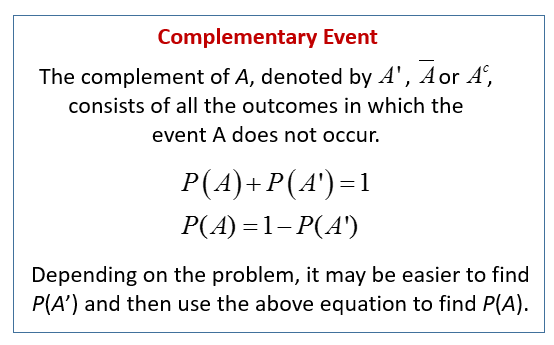
Let A be an event and A be its complement. Experts are tested by Chegg as specialists in their subject area. P E 1P E E.
In other words it is the ratio of favorable outcomes to un favorable outcomes. P E 1 - P E B. Choose the three formulas that can be used to describe complementary events.
Then the three formulas describing these two events could be. The event tossing tails and rolling a 1 or 2 is a simple event. P E P E F.
P E 1 - P E G. PA PA 1. And 40 60 100.
P E - P E 1. P E 1P E Answer. Event A plus all outcomes.
All Probability Formulas List in Maths. This trick is often used when calculating the probability of multiple events. PAB PA PB PAB Rule of Complementary Events.
PE1- PE PE1-PE Determine whether the statement is true or false. We review their content and use your feedback to keep the quality high. The Complement of Event A is 1 2 3 4 Number of ways it can happen.
List the three formulas that can be used to describe complementary events. 0 PA 1. Let us add them.
Choose the three formulas that can be used to describe complementary events. P E P E1. 1 Cour Choose the three formulas that can be used to describe complementary events Assly Select the three formulas that can be used to describe complementary events.
False the event is not simple because it consists of two possible outcomes. P E P E 1. Statistics and Probability questions and answers.
It makes sense right. P E P E 1. Determine whether the following statement is true or false.
Select the three formulas that can be used to describe complementary events. P A C 1 P A The following example will show how to use the complement rule. The event tossing tails and rolling a 22 or 55 is a simple event.
Total number of outcomes. You toss a coin and roll a die. PA B PB A PA PB.
B event of drawing a blue card. Choose the three formulas that can be used to describe complementary events Select the three formulas that can be used to describe complementary events. The complement rule is stated as the sum of the probability of an event and the probability of its complement is equal to 1 as expressed by the following equation.
The probability that event A does not occur is the complement of A. For example if the odds of it raining is 40 the odds of it not raining must equal 60. PA 4 6 2 3.
If two events are independent P ABP B. Let A event of drawing a red card. P A C P A 1.
P Eequals1minus P E P Eequals1minus P E You toss a coin and roll a die. P E P E P E B. P E 1 - P E F.
In the example nnot rolling a 4nrolling a 4516. Yep that makes 1. False the event is not simple because it consists of two possible outcomes.
The complimentary event of an event say eqA eq is generally denoted as eqAc text or A eq Answer and Explanation. The complement of at least one is none So the probability of getting at least one item is equal to 1- P none of the items. The probability of notrolling a 4 is ⅚.
Three formulas that can be used to describe complementary events. Find step-by-step Statistics solutions and your answer to the following textbook question. P E-P E 1 D.
So the event not rolling a 4 is the complement of the event rolling a 4. Select the three formulas that can be used to describe complementary events. P E P.
Who are the experts. The odds of an event is the ratio of the probability of an event to the probability of its complement. PA B PAB PB Bayes Formula.
Select the three formulas that can be used to describe complementary events. Select the three formulas that can be used to describe complementary events. PAPA1 or PA1-PA PA means probability of not A.
For example the odds of rolling a 5 or greater. P EP E 1. 1 PA1-P A PA is the probability of event A.
PA PA 1 3 2 3 3 3 1. Choose the three formulas that can be used to describe complementary events. We say the odds are 3 to 2 which means 3 favorable outcomes to every 2 unfavorable outcomes and we write 3.
Pnot A 1 - PA Examples. If it is false rewrite it as a true statement. PAB PA PB Conditional Probability.

What Are Complementary Events In Probability Statistics Definition And Formula Youtube

Probability Of Complementary Events Sample Space Youtube

Complementary Events Definition And Examples Magoosh Statistics Blog
Probability Of Complementary Events Sample Space Youtube


0 Comments